
Historical Context and Ongoing Dynamics: A Brief Exploration of the Israel-Palestine Conflict.
In today’s world, understanding the nuances of the Israel-Palestine conflict is essential. This brief article serves as a valuable starting point for grasping the historical context, key events, and ongoing dynamics that have shaped the ongoing and confrontational issue of the Middle-Eastern conflict.
The following account does not serve as a comprehensive insight, but more a starting point for the curious, and will provide valuable insights into a multifaceted story that continues to impact the international stage.
Historical Background and the Emergence of Zionism
The Land of Palestine was home to Muslim, Christian, and Jewish indigenous Arabs among others who largely cohabited in peace. But in the late 19th century, a controversial vision emerged in Europe—an idea that would spark a tumultuous saga in the heart of the Middle East. This belief aimed to establish a Jewish nation in the ancient land of Palestine.
At the time, Palestine was governed by the Ottomans until after World War I when control was transferred to the British Empire under a mandate granted by the League of Nations, the precursor to the United Nations. It followed their defeat at the battle of Megiddo.
The Balfour Declaration
Following the fallout of a brutal and devastating First World War, the British government issued the Balfour Declaration in 1917, expressing support for “a national home for the Jewish people” in Palestine. Arab protests began, later intensifying against an increase of immigration by European settlers.
Palestinian Arabs believed unrestrained immigration to Palestine would end in their displacement, potentially leading to unrest, a concern that would later be validated.
To mitigate the concerns of both Jewish and Arab communities, the British administration reneged on certain policies within the region, which brought about reduced entry for Jewish immigrants.
Aftermath of World War II
In the aftermath of World War II, rising anti-Semitism, fueled by Nazi propaganda and conspiracy theories, particularly in Europe and North America, led some Jewish individuals to express concerns about their safety in their native countries.
Debt-laden and reeling from war at home, the British government decided to transfer the power of Palestine to the newly established United Nations. Subsequently, they began developing a partition plan to create distinct administrative districts for Arabs and Jews.
European writers further compounded the idea of a need for a “Jewish Homeland”, a movement that became known as ‘Zionism.’
Writers including Leo Pinsker who penned “Auto-Emancipation”, Theodor Herzl, responsible for “The Jewish State” and Max Nordau‘s publications influenced a throng of groups that would go on to inspire active militant aggression in the state of Palestine.
These beliefs stem from an extreme interpretation brought about by a mix of writings far removed from the Torah, instigating a period of disparity and conflict which continues today.
Understanding the “Terror” Campaign
Amid British control of Palestine, several extremist Zionist groups, including the Irgun (Etzel) and The Stern Gang (Lehi), emerged. These groups carried out campaigns of violence against British authorities, including attacks on military and administrative installations such as the King David Hotel bombing in Jerusalem in July 1946. They also targeted British interests in Palestine and beyond. One notable incident, known as The Sergeants affair, involved the abduction of British troops in response to the imprisonment of Zionist fighters captured due to their militant activities. Numerous individuals were targeted, resulting in casualties, including some notable figures.
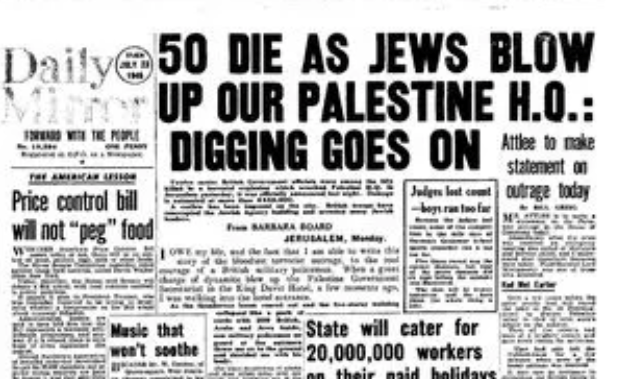

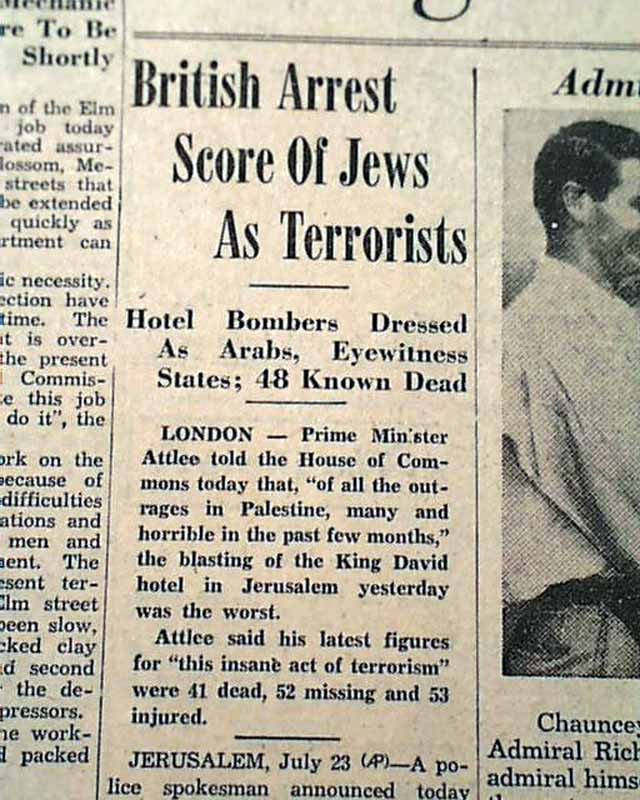


1944: Several British officials and informers were assassinated, including Walter Guinness, 1st Baron Moyne, a British dignitary who was shot several times at close range by Lehi members Eliahu Hakim and Eliyahu Bet-Zuri.
1947: The commander of Police in mandatory Palestine Ralph Cairns, was assassinated using a landmine filled with fifteen kilograms of demolition gelatin and five kilograms of metallic objects.
1948: Folke Bernadotte, who was appointed by the United Nations to mediate peace between Arabs and the Zionist movement was shot 6 times through the window of a UN-led jeep.
1948: The High Commissioner for Palestine, Alan Cunningham survived an ambush attack, though several members of his convoy were injured.
The Birth of Israel
Approval to partition Palestine was not sought from the Palestinian population, and in 1947, the United Nations General Assembly passed Resolution 181 (II). This resolution called for the division of Palestine into separate Jewish and Arab states, along with an international administration for the district of Jerusalem. This decision was made without the consent of indigenous Arabs and has been a point of contention in the history of the Israel-Palestine conflict.
Despite fierce political opposition to the creation of an Israeli state, the State of Israel was formally recognised on May 14th 1948. David Ben-Gurion, a frequent collaborator of the designated terrorist groups Irgun and Haganah, declared Israel’s independence and later became its first Prime Minister.
The declaration was followed by a significant influx of Zionist Jewish immigrants, which has had a lasting impact on Palestinian Arabs. The ‘Law of Return‘ allows individuals who identify as Jewish, including those from abroad, to claim citizenship in Israel. However, this policy often results in the displacement of Palestinian Arabs, whether they are Muslim or Christian.
This displacement has been a central issue driving the conflict, with many Palestinians forced to leave their lifelong homes to allow Zionist Jewish populations to replace them in their own homes. Following their exile, they become refugees, often seeking safety in neighboring countries like Jordan remaining stateless.
Why Are Israel and Palestine at War in 2023?
As of 2007, Israel implemented a blockade on Gaza, limiting access to essential resources such as power, food, and medical supplies. Additionally, the IDF occasionally enters Gaza, leading to clashes with civilians, including arrests and, at times, fatalities. Subsequently, the public’s discontent led to the election of Hamas, a party that adopted a confrontational stance towards Israel, often avoiding diplomatic channels. Despite ongoing volatility, finding a solution remains challenging.
The Israel-Palestine conflict is characterised by a history of European colonialism and unresolved issues. Israel’s expansion efforts, including the bulldozing of Palestinian settlements, continue to escalate tensions. Meanwhile, Hamas intermittently fires rockets, frequently in response to perceived provocations.
The proposed two-state solution, while a potential remedy, faces resistance from Hamas, following the continued expansion of Israel’s settlement activities which further complicates the path to resolution. While the causes of the conflict are not complex, ending it will be.
 Stanisland Magazine
Leave a Reply
You must be logged in to post a comment.