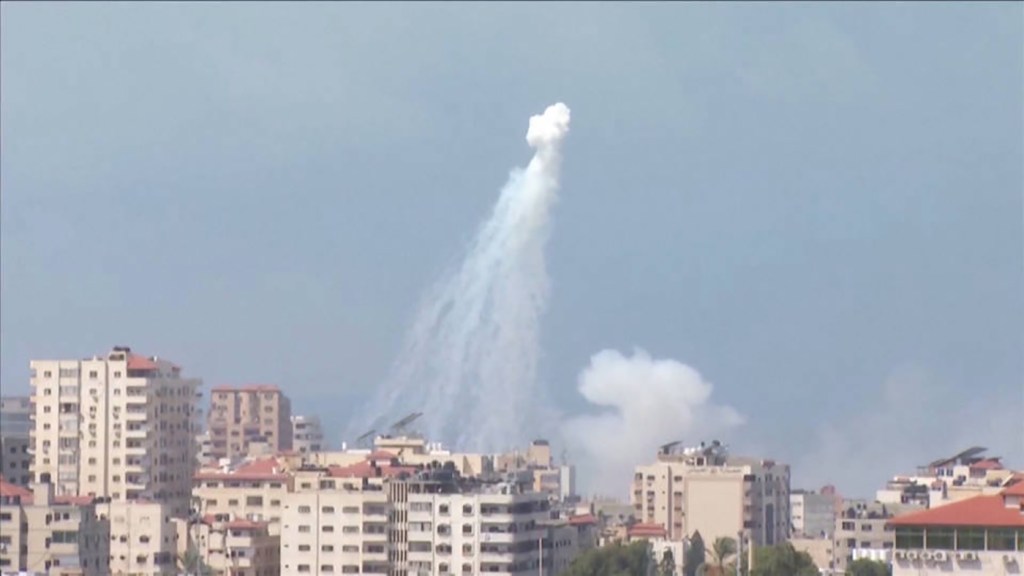
Analysis shows Israel is using white phosphorus against Gaza’s civilian population.
Israel has been accused of using white phosphorus in Gaza, an an incendiary chemical weapon that is banned under international law. It is governed by Protocol III to the CCW (Chemical Weapons Convention), as their use poses severe risks to civilian populations due to the devastating biological effects of these substances.
A report published by Human Rights Watch implicated the Tel-Aviv government in the deployment of the chemical agent against civilians in Gaza following its examination of video evidence.
What is white phosphorus?
White phosphorus is a general component of military arsenals, primarily employed to shroud terrestrial military manoeuvres. It facilitates the creation of a visual obstruction through the emission of a smokescreen, functioning effectively during daily and nocturnal military operations.
Simultaneously, it possesses the unique capacity to disrupt infrared optical systems and weapons tracking mechanisms, thus imparting safeguarding attributes to military contingents against precision-guided armaments, notably anti-armor missiles.
When employed in an aerial fashion, white phosphorus offers the distinct advantage of encompassing extensive areas, proving invaluable in concealing large-scale troop displacements.
However, this method concurrently extends the reach of incendiary effects across a broader topographical expanse, thereby heightening prospective hazards to civilian inhabitants, especially within densely populated regions like Gaza. Conversely, groundburst deployment concentrates the risk zone while maintaining an extended duration of smokescreen. The durability of the white phosphorus cloud is intricately linked to atmospheric dynamics, precluding precise predictions regarding its longevity.
Furthermore, white phosphorus demonstrates utility as an incendiary instrument, typified by its use by United States military forces during the second Fallujah battle in Iraq in 2004, where it was employed to unveil concealed combatants, subsequently rendering them susceptible to military intervention.
How does white phosphorus cause fatality and disability?
White phosphorus exposure produces severe and protracted burns, characterized by their potential to extend to subdermal layers (often to the bone) and a tendency for infection development. Residual white phosphorus fragments, if left unaddressed, pose a persistent hazard, potentially resurfacing when exposed to atmospheric oxygen.
Minimal exposure can significantly elevate the risk of fatality
These burns, even when affecting only 10% of the body’s surface area, carry a heightened risk of fatality. Furthermore, inhalation of white phosphorus smoke may induce respiratory damage and contribute to multiple organ failure.
Survivors of such incidents frequently endure a lifetime of enduring anguish. The emergence of muscle contractures, signifying the irreversible alteration of muscles and surrounding tissues, impairs physical mobility.
Psychological distress stemming from the trauma of the initial exposure, the anguish of treatment procedures, and the conspicuous disfiguration resulting from these burns contribute to social ostracization and enduring mental distress.
The potential to render farmland and crops nonviable
Moreover, white phosphorus-induced fires possess the capacity to devastate civilian infrastructure and property, detrimentally impact agricultural yields, and decimate livestock populations.
To exacerbate these challenges, the scarcity of resources available to medical practitioners operating within Gaza hinders the effective management of severe burn cases.
 Stanisland Magazine
Leave a Reply
You must be logged in to post a comment.