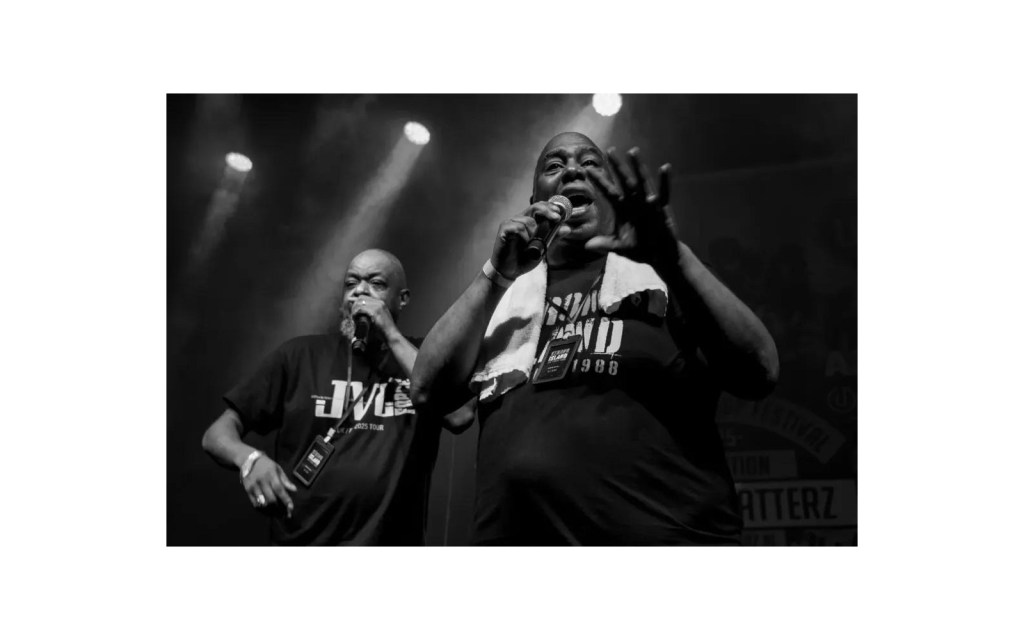
Stanisland Magazine talks with the legendary Long Island crew JVC Force about all things hip-hop and what it takes to make it
Legends occupy a space with mutual respect. JVC Force is part of that same realm, where pure hip-hop meets enthusiasm for the game. Hailing from Long Island, they share history with notable names such as Public Enemy, Craig Mack Eric B and Rakim, Biz Markie, and Keith Murray. Recently, the crew toured Europe and were welcomed in London to perform with a thunderous reception. Stanisland Magazine sat down with the legends made up of AJ Rok and B-Luv to talk all things music, their connection to Dave of De La Soul, history, and their fans.
How did you connect?
B-Luv: “We connected through friendship. I met A.J. when I was five years old. He was seven years old. By the time, I think I got to 10th grade, we started to make music, and we hooked up at a party that we were DJing at, and some of our friends brought him over. So, of course, we rapped together, and everybody said we sounded good together. The following day, we sat down and started writing routines.”
How did your writing process work?”
AJ Rok: “Some of the joints, I wrote my part, and B-Luv wrote his part, and we just rocked it. B did the heavy lifting with the writing. I was handling a lot of the business, radio promotions, and publicity. We didn’t know what those things were; we just wanted to be in magazines and on the radio so the girls would see us (laughs). We didn’t know they had a word.”
How did your parents react when you first started rapping?
B Luv: “They were supportive. They were always very supportive. However, there were terms for the music. I couldn’t become a professional unless I went to college. My parents are from the West Indies, so that’s the standard, you know what I mean? So I had to make sure that I was enrolled in college. I was on my way doing what I was doing, I was passing college. Otherwise, with my parents, all bets were off.”
Did that put strain on the music?
AJ Rok: “No, B Luv was in college when things started to kick off. When it was time to do stuff, he would come down. Like when we had to open up for Big Daddy Kane, he just came from college, and we did the show, then he went back. He was doing his homework on the plane!”
B Luv: “I was a communications major for radio and television, and my professor at that time agreed to allow me to turn my work in from off the road. So he gave me all of my assignments, and I took them on the road, and while we were in each Airport, I had to complete my assignments. After the single came out before we started touring, it was playing all over my college, at the Black student union, and on the college station. So everybody was pretty much hearing it. So my professor knew, and he later learned I was getting a little more popular.
But he pulled me aside one day, and he said, I know this is an opportunity for you, he said, “Can you handle this on the road?” Like, in other words, when you’re in the airports and stuff, “can you go ahead and handle doing your homework and come back and turn everything in?” And I said, “Yeah”, it was a little bit of a struggle, because it was a lot of work and stuff, but every time we were in an airport or hotel, I would do my homework. I would bring it back to school, turn it into them, and he would grade it, honestly, and stuff, and, I mean, the communications, radio, and television, talking to people, writing, came natural for me. So I excelled in that area. So, um, he took it. He passed me, passed me year after year, you know, so eventually I got my degree.”
What were you doing at the time?
AJ Rok: “So, I kind of was the go against the grain guy.
I wasn’t listening to my parents. All I cared about was hip-hop and getting high and doing music and, you know, freestyling in the park. So, that got me in trouble several times, but that’s part of the story. I was born in Mount Vernon, New York, and my parents bought a house in Central Islip when I was seven. That’s when we met.
Then, my parents broke up, and I drove my mother crazy, so she sent me back to Mount Vernon to live with my father for high school — which is right on the borderline of the Bronx, which exposed me to the Cold Crush and all the early stuff I got to hear, you know, before records.
He (B-Luv) started making some noise in CI, and they were doing a party and our friends, mutual friends, were like, “You got to go see what they’re doing. But I didn’t really want to be out there. My father sent me back to my mother’s house. (laughs)
I went to the party, and they said, “Let AJ, get on the mic”, and then, you know, we were rocking back and forth, and everyone talked about how good we were together. But my mother eventually made me do something — I went to Island Drafting and Technical Institute, me and Dave from De La Soul, we both were in the class. He was the quiet kid in the corner that you never knew would be a rapper, and he’s the one who made it big. I was the loud, big-mouthed student in class.”
Were there any specific battles?
AJ Rok: “No, not really, just on the block, you know, more like cyphers. But there was a few battles when I first moved back to Mount Vernon from Long Island. I’m in 10th grade, and there’s this guy who made a lot of noise — I’m not going to say his name — he decided to try and bully me, right. So, we’re in the courtyard, he ran up and was like, “yo, start rhyming, I’m going to battle you. I’m gonna take you out.” ‘You don’t belong here’, kind of thing. I ate him up — then all his friends became my friends, and then he wanted to fight. So that was my one real battle.”
What was it like coming up on the block?
AJ Rok: “Music was always a part of my life. My dad had a big musical sense, and always played a lot of music in the house and I would start playing music at some of their parties — I actually used to DJ, in the beginning. We had a record changer and a record player, the one that was attached to a receiver or whatever, it was on top, and there was no mixer. So you had the button that went into the phono, something else, tape, and auxiliary. So I would have to switch the other turntable auxiliary and go switch it to phono, switch it to auxiliary, switch it etc. That’s how I was DJing.”
With ‘Long Island’, how was it recorded?
B-Luv: “First thing I want you to know is that initially, the group didn’t get a record deal for “Strong Island“. We got a record deal for a flip side called “Nu Skool“.
AJ Rok: “Which was actually a solo record he did before I joined the group”.
B-Luv: “And that was a solo record that I had recorded in a musical booth in a theme park on a senior trip. You know, they have the little booth — you go in there, you choose the music you want, and they had no hip hop in there, so my classmate, he did the human beatbox, and I rapped the Nu Skool song. And that’s the only one that we had at the time, that we could package and send to labels. We packaged it up about 20 times and sent it to about 20 labels.”
How did you find your sound?
B-Luv: “We were coming out right behind Boogie Down Productions and their album ‘Criminal Minded‘, which was tremendous. We felt like we had big competition coming behind Boogie Down. We had to choose our beats and, fortunately for us, like I say, again, our engineer, Charlie Marotta was so advanced, he had dance hits in, I think, the ’70s — that’s how he got our studio. But we were coming through at a time that was as sample-friendly as ever. No one was suing, no one.
The radio has space. The soul records were, it was a big collection that you can choose from. And unlike rappers from the City that were rapping mostly off with break beats and cutting them up back and forth, we’re in Long Island, growing up around water, pools in our yard, listening to everything from Soul Music to Hall and Oates, Billy Joel, Pat Benatar. Since we DJ, we know the music that people like to dance to, and what it is that they like. For instance, “Doing Damage“, Louis Louie. It doesn’t matter what color you are, Louie Louie is a great song.
But we had access to that. And the thinking process with us being from the suburbs, was different than the city thinking. So, we dug through a lot of music, and we found the music that we really wanted to use. I think the cool thing was, a lot of the soul artists that we sampled, they were fading away and a little piece of their song was sampled — they got to come back and do shows.”
How was Long Island perceived in hip hop?
AJ Rok: “Back then, if you weren’t from the five boroughs, you weren’t “real hip hop.” A lot of Long Island artists weren’t known to be from Long Island — people thought we were from Coney Island when we said “CI.” Strong Island stamped the place. Groups after us said it made them proud. But we couldn’t rap about robberies or crack. We had lawns, beaches, marinas. So we had to be more creative. That’s why when Doing Damage dropped, labels didn’t even know how to market us — we were dope, but we were educated, cut our grass, listened to our mums. And that was real”.
On fans keeping their name alive…
AJ Rok: “So this is our 37-year anniversary. This is our first time to London. We came out at the time when we never had an official video. There was no internet. There were no cell phones, there was no social media—all the things that all these artists live off of now. And the fact that we’re here talking to you 37 years later is because of the fans: all the people that will read this, that are coming to the show, that share our stuff over the internet for all these years—they kept the name alive. We’re here, and we have this resurgence. So we owe it to the fans, I just wanted to put that out there. We are grateful to them…”
READ MORE: The Latest and Most Important News in Music
B-Luv: “…the thing about it is that Europe, the UK, Germany, they held us down. And have continued to hold it [down]….”So we were there. We saw the wall because we had to go across the wall to Berlin to do the show and come back.”
“You can’t have people that bought all your albums, listened to you for 30 something years, and you’re going to be the kind of artist that’s like, oh, I don’t have time for them. We have time for everyone.
AJ Rok: “I still do that now. I mean, I’ve talked to a lot of people and I met them in the Netherlands and they’re like, ‘oh, I’m so-and-so. Oh man, I’ve been talking to this guy for 5 years’. We finally met each other. You know, but we’ve been talking online, I met about 4 or 5 people that I’ve been talking to for over 5 years that I had never met before. In person.”
How do you perceive the change of access to recording?
AJ Rok: “You had to go in the studio, you had to sign to a major label, so you could get your music to the world. Now you can be in your basement and do something and put it on the internet. But it was Pandora’s box—it opened it up to everybody.
Sometimes you have to go through all of that to find the gems now. Like, it’s saturated. There’s no gatekeepers; like, it’s just everybody. There’s nothing stopping you from doing you, going in the house right now, doing something, and putting it on the internet tomorrow. They spread it, and then you—the sensation, you know what I’m saying?
You also had to, back in the days, be able to rock the shows before you had the right to have a record. A record contract was like a privilege, not a birthright.”
Are there any UK artists you’re listening to?
B-Luv: “I was introduced last night to Roots Manuva, “Witness The Fitness”. Man, that shit is so hard to me.” That, yeah, he that was really like, yeah, witness the fitness. And I’ve seen the people.
There was another group too (FLO – Fly Girl) that, um, they had a video and stuff, and I think they had Missy and all of them in there, and it was like they were in the basement, like break dancing and stuff.
 Stanisland Magazine
Leave a Reply
You must be logged in to post a comment.