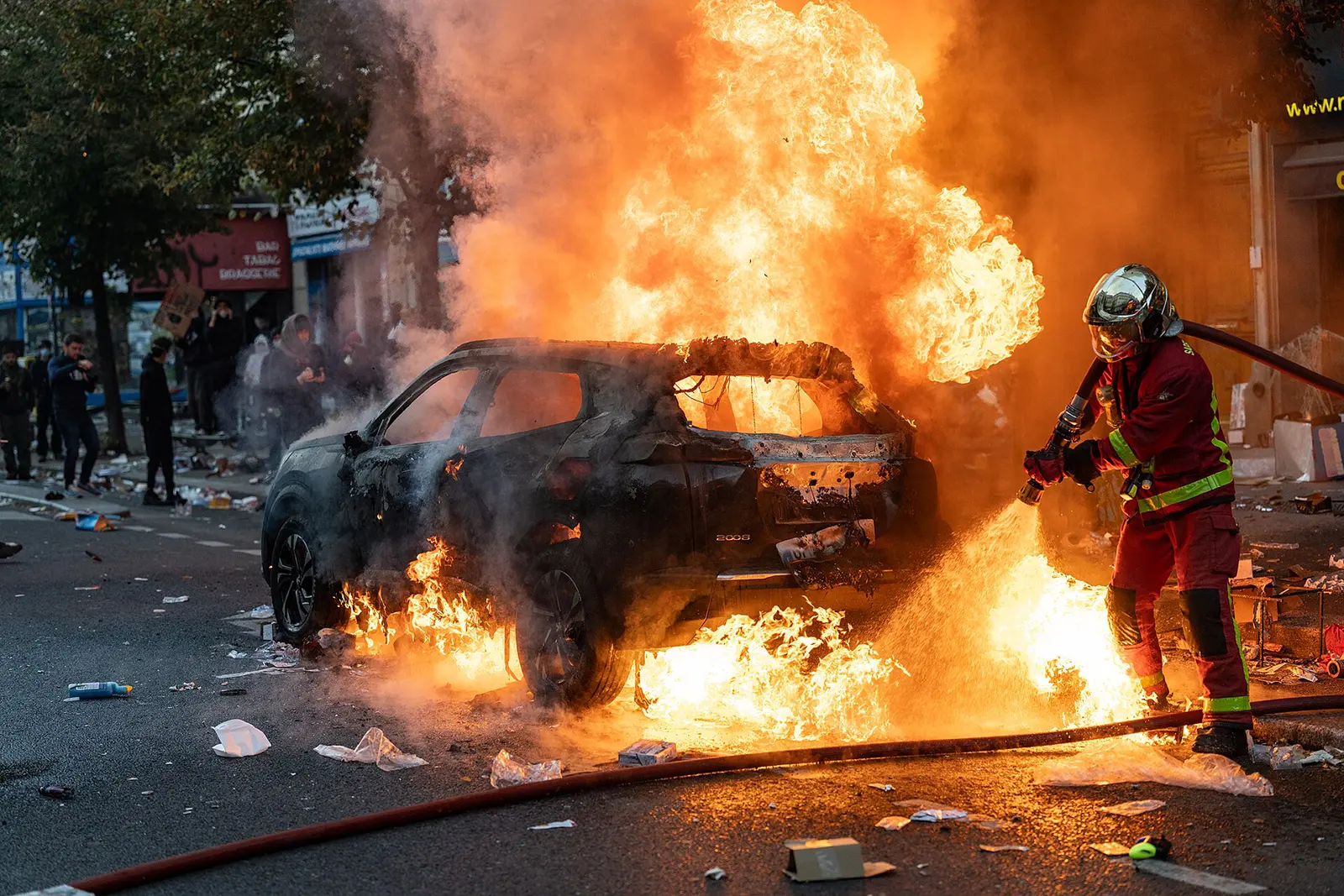
The French government remains in a state of panic as it attempts to contain protests, which have descended into riots and chaos, fuelled by anger at the establishment.
France’s continuing riots mount following a weekend of unrest, police and fire and rescue interventions. One of Limoges’ most iconic landmarks, its historic town hall and clock tower, burned as tensions mounted over public spending and public demands. Underlying the disorder is the historical politics surrounding it, while rumours of plans to declare a state of emergency circulate. However, President Emmanuel Macron’s government has opposed declaring a state of emergency, though it has acknowledged that some security measures could be introduced.

Protests and Riots Continue
The weekend has seen more protests erupt, including looting. President Emmanuel Macron said: “Those who looted will have to pay for the damage, and those who sought to bring down the Republic will be held accountable.” On X, Interior Minister Laurent Nuñez said: “The right to protest is a fundamental right. Deliberately and collectively sowing disorder through violence is not.” Rioting continued throughout the country, including in Marseille, Paris and Lyon.
As the town hall clock in Limoges burned to the ground, the public were in a sombre mood, with one saying: “It broke my heart. I saw Notre Dame all over again, except this time it was our town,” while others anonymously suggested that, like Notre Dame, placing importance on a building rather than the rights and protections of its civilians is exactly why people are protesting.

One anonymous student told Democracy Now!: “Someone lost an eye. Someone lost a hand. And this is happening to literal teens, literal children. We even — most of us aren’t even adults yet.” Amnesty International responded to the French authorities’ handling of the protests: “Any policing response must be lawful, necessary and proportionate, and authorities must avoid unnecessary and excessive use of force.”
Others blamed fringe groups or “agitators” for its demise and believed it distracted from the formal points being raised. One social media user said, in reference to the council building’s destruction: “None of the budgets being contested in the demonstrations are voted on by town councils.”
Another commenter said: “They’re in the process of radicalising an entire generation, if not two. Incredible that they don’t realise it,” while another exclaimed: “I’m waiting for a call for a national strike so that employees can join in.”
Why Are People Protesting?
The French government now owes approximately €3.6 trillion, equivalent to 119% of its GDP. Public expenditure reached 57.2% of GDP in 2025, far beyond the eurozone average owing partly to pensions, healthcare and social protections.
The country’s ageing population adds to the pressures facing not only its government but the people it supports, as it now must strike a careful balance to avoid an unsustainable debt burden. Its debt continues to grow amid persistent budget deficits and rising borrowing costs, whilst weak economic growth stifles efforts to contain it.
Protesters took to the streets amid growing economic pressures, which have been accompanied by deteriorating schools and teacher shortages, adding to a burgeoning set of undesirable conditions, as well as demands over wages, a cost of living crisis, and restrictions on public spending and pensions.
Some students have said that infrastructure and educational necessities are not being met, like Maelle, 16, a student in Caen, who said: “against this government that doesn’t invest in heating, air conditioning, or teachers’ salaries.” A teacher near Paris, Amélie Pacaud, agreed, saying: “We’re roasting in a sealed oven.”
However, President Emmanuel Macron’s government has made some concessions, including a pledge to deploy 3,000 additional substitute teachers and an initiative to hear student grievances. His Prime Minister, Sébastien Lecornu, announced measures to address diesel prices, though these still fall short of what protesters have demanded.
Photo: Jorge Jaramillo CC BY-SA 4.0

Sarajevo Safari: New Developments Emerge Following Austrian Investigations
The so-called Sarajevo Safari, which allegedly involved wealthy foreigners hunting Bosnians for sport, may see its first case brought against…

Reform UK Exposed For New Round of Racism
ITV News uncovered rampant racism in the far-right nationalist political party Reform UK, yet their popularity continues to climb.

To Exploit and Profit: It’s Time To Ban Filming Without Consent
We all deserve privacy and protection from unsolicited viral profiteers, and public support is strong.
Leave a Reply