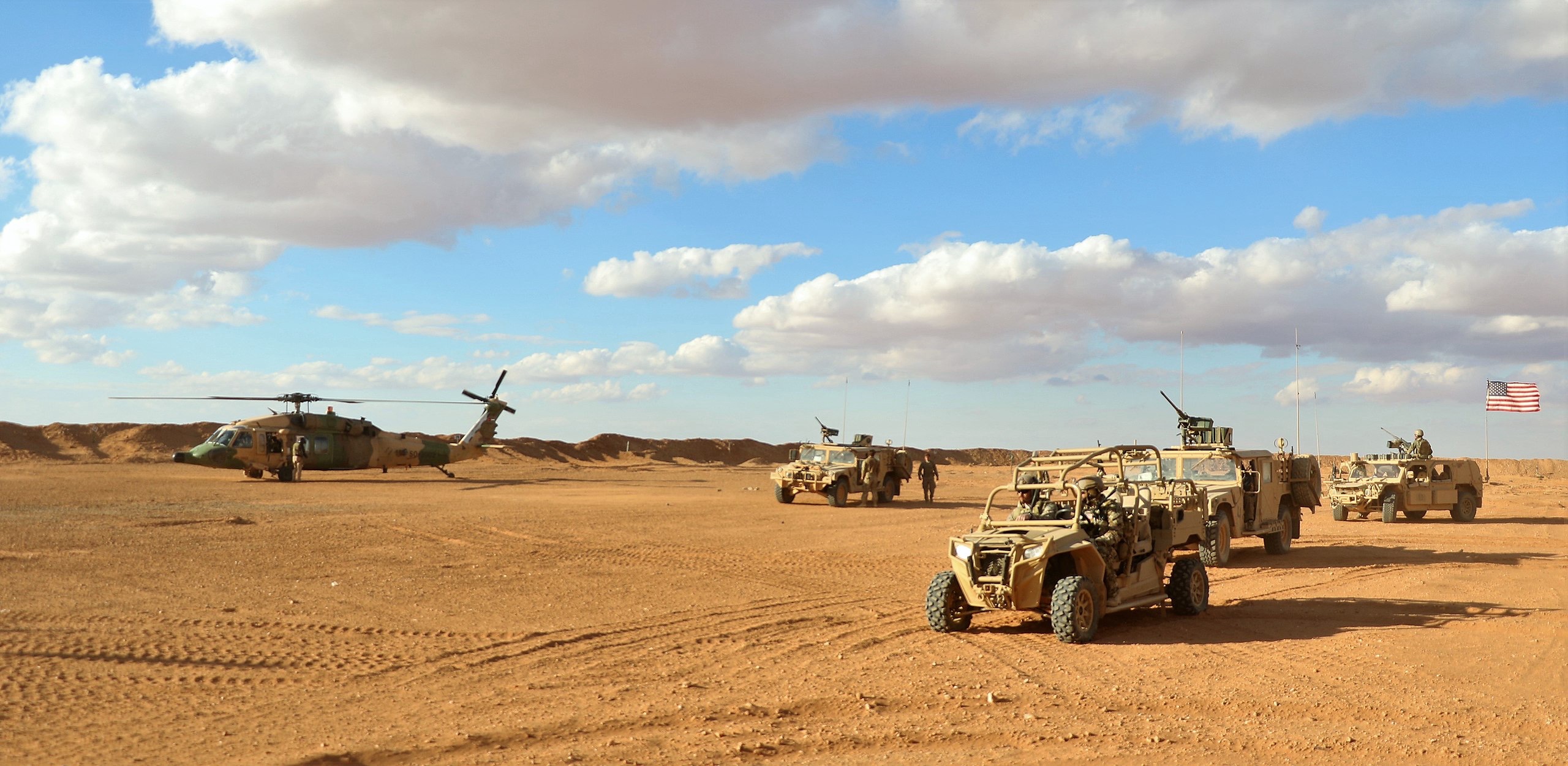
Defence Secretary ups rhetoric of attacks against US troops amidst Middle East tensions.
Secretary of Defence Lloyd Austin’s recent remarks raise concerns about the potential escalation of tensions in an already volatile Middle East. Simultaneously, as Israel continues its military actions in what remains of Palestine, the presence of approximately 30,000 U.S. troops in the Middle East prompts questions about how terrorist groups are allowed, and continue to strengthen.
Austin asserts Middle East position
Remarks on the US’ mission in the region caused by incoming attacks by unknown groups inspired comments about its operations. He told ABC News that he will do what’s necessary to bolster forces to ensure “they’re protected and that we have the ability to respond.”
“If any group or any country is looking to widen this conflict and take advantage of this very unfortunate situation that we see. Our advice is don’t” Austin said in a statement. “We maintain the right to defend ourselves and we won’t hesitate to take the appropriate action.”
The defence he is referring to pertains to what many have labeled the United States’ “endless war” – a state of conflict with no clear conclusion due to the uncertainty surrounding adversarial hierarchies.
The United States says it maintains its presence in Syria to combat ‘Daesh’, although with an outpost situated in the oil-rich town of Al Omar and the Al Tanf base, there may be more to their claims of attempting to combat the militant group. Some may assume that a presence is to safeguard their interests in the region rather than repelling a force that hasn’t been the same since its overthrow in 2016.
Austin later said: “we’ve seen rocket and UAV (unmanned aerial vehicles) attacks against bases housing our troops in Iraq and Syria. We’re concerned about a potential escalation. In fact, what we’re seeing is a is the prospect of a significant escalation of attacks on our troops and our people throughout the region.”
Extremism thrived under the leadership of the US
Escalation, however, doesn’t significantly impact the United States, considering they have the option to withdraw at any time. Contrastingly, nations in the region have experienced a notable increase in attacks, with no ability to uproot their statehood.
Syria was recently targeted in an air raid by Israeli forces just a few days ago, and anti-Assad forces are still being shelled by troops backed by Damascus. Regardless of the outcome, whatever decision the United States makes, their presence in the region has seemingly contributed to the rise of extremism rather than diminishing it. Though Al Qaeda carried out one of the most saddening and destructive acts of terrorism, arguably in history, the groups that proliferated from the occupation of Iraq and Afghanistan were catalysed by a coalition presence in the Middle East.
Since a coalition presence in the Middle East, militant groups have exploded in popularity and force which includes cells of Daesh among others.

Nigel Farage Wins But Proves He Is an Incapable Leader
Nigel Farage's election win proves he will run away at any sign of a confrontation.

Opinion: New Muslim Integration Research Reveals Modern Britain
No matter what Muslims do, Britain refuses to accept us.

Nigel Farage Fights for Survival Following £5 Million Gift Row
The Reform Party leader and MP for Clacton-on-Sea will stand in a by-election for his own constituency.
Leave a Reply